Every cyclist wants to ride faster, farther, and more comfortably. Many riders invest in expensive bikes, upgraded components, and premium cycling gear, but often overlook one of the simplest and most important factors affecting both comfort and performance: saddle height.
A saddle that is positioned too high or too low can affect the way your legs move, reduce pedalling efficiency, and create unnecessary stress on your knees, hips, and lower back. Over time, an incorrect saddle position can also contribute to discomfort and may increase the risk of cycling-related injuries. The good news is that saddle height is one of the easiest aspects of your bike setup to adjust.
Understanding the importance of saddle height and knowing how to identify the right saddle height can make your rides more comfortable and efficient. Before making expensive upgrades to your bike, it is worth taking a few minutes to check whether your saddle is set correctly.
Why Saddle Height Is So Important
Your legs generate power with every pedal stroke, and the position of your saddle directly affects how efficiently that power is produced. When the saddle is at the correct height, your legs can move through a natural range of motion, allowing your muscles to work effectively throughout the pedal stroke.
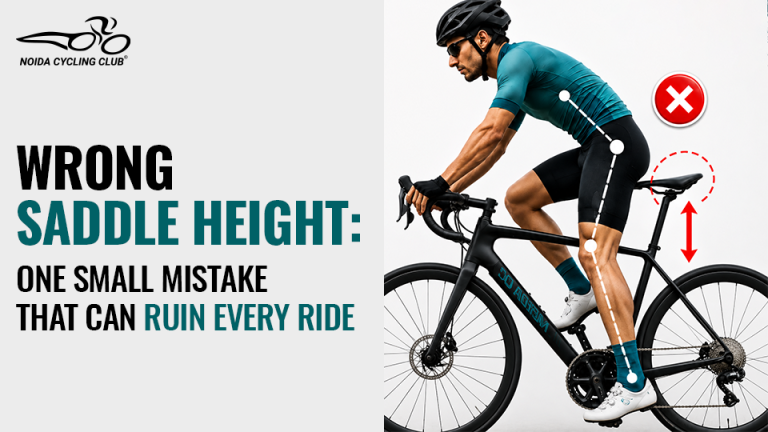
If the saddle is too low, your knees remain excessively bent and the altered joint position may affect how efficiently your muscles produce power. On the other hand, if the saddle is too high, you may have to stretch to reach the pedals, causing your hips to move from side to side potentially increasing strain on your knees, hips and lower back.
A properly positioned saddle can help improve pedalling efficiency, make longer rides more comfortable, and reduce unnecessary strain on the knees and hips. It can also help you maintain a more stable and controlled position on the bike, allowing you to focus on enjoying your ride rather than constantly adjusting your body.
Signs Your Saddle Is Too Low
One of the most common saddle-height mistakes, particularly among beginner cyclists, is setting the saddle too low. A low saddle keeps the knees more bent than they should be throughout the pedal stroke, which can make pedalling feel harder than it should.
You may notice discomfort or pain around the front of your knees, especially during longer rides or when climbing. Your legs may also feel fatigued sooner than expected, even when riding at a moderate pace. Because your legs remain more flexed throughout the pedal stroke, you may find it difficult to generate power efficiently or maintain your usual speed.
A saddle that is too low can also make you feel cramped on the bike. If you regularly experience these symptoms, checking your saddle height could be a simple first step toward improving your riding position. However, these symptoms can have other causes, so they should not be used on their own to determine whether your saddle is too low.
Signs Your Saddle Is Too High
A saddle that is too high creates a different set of problems. Instead of keeping your knees excessively bent, it forces your legs to reach too far toward the pedals at the bottom of each stroke.
One of the most noticeable signs is that your hips begin to rock from side to side as you pedal. You may also experience discomfort behind the knees or feel that you are constantly stretching to reach the pedals. Some riders may notice lower-back discomfort as a result of the altered riding position caused by excessive saddle height.
A saddle that is too high can also affect your stability and control, particularly when riding at higher speeds or on uneven surfaces. If you find yourself moving around on the saddle or struggling to maintain a smooth pedal stroke, the saddle may be too high and may need to be lowered slightly.
A Simple Way to Check Saddle Height
There are several professional methods for determining the ideal saddle height, but a simple heel test can provide a useful starting point for most cyclists.
- Place your bike against a wall or secure it on an indoor trainer so that it remains stable.
- Sit naturally on the saddle and place your heel on the pedal.
- Rotate the crank until the pedal reaches its lowest position.
- Check the position of your leg. Your leg should become nearly straight without requiring you to tilt your hips or shift your body to reach the pedal.
When you return your foot to its normal pedalling position, with the ball of your foot over the pedal, your knee should retain a slight bend at the bottom of the pedal stroke. This gives your legs enough extension without forcing them to overreach.
The heel test should be treated as a starting point rather than a perfect measurement. Different cyclists have different body proportions, flexibility levels, riding styles, and bike setups, so small adjustments may still be necessary to find the most comfortable position.
Small Changes Can Make a Big Difference
Once you have identified that your saddle may be too high or too low, avoid making a large adjustment all at once. Even a small change can noticeably affect how your body feels on the bike.
A good approach is to adjust the saddle by around 2–5 mm at a time and then take a short ride to evaluate the difference. Pay attention to how your knees, hips, lower back, and overall pedal stroke feel. If the position feels better but still does not feel completely natural, make another small adjustment and test it again.
This gradual approach allows your body to adapt and makes it easier to identify the position that works best for you. Remember that the correct saddle height is not simply about achieving a particular measurement; it is about finding a position that allows you to pedal smoothly, comfortably, and efficiently.
Final Thoughts
A comfortable and efficient ride does not always require an expensive bike upgrade or new cycling equipment. Sometimes, one of the biggest improvements can come from a simple adjustment to your existing setup.
Before your next ride, take a few minutes to check your saddle height and pay attention to how your body feels while pedalling. A small adjustment could make your ride smoother, reduce unnecessary discomfort, and help you ride more efficiently.
Ultimately, the best bike fit is one that allows you to ride comfortably, efficiently, and confidently for miles to come. If your saddle height is appropriate, every pedal stroke can feel more natural—and that can make a significant difference to your overall cycling experience.