
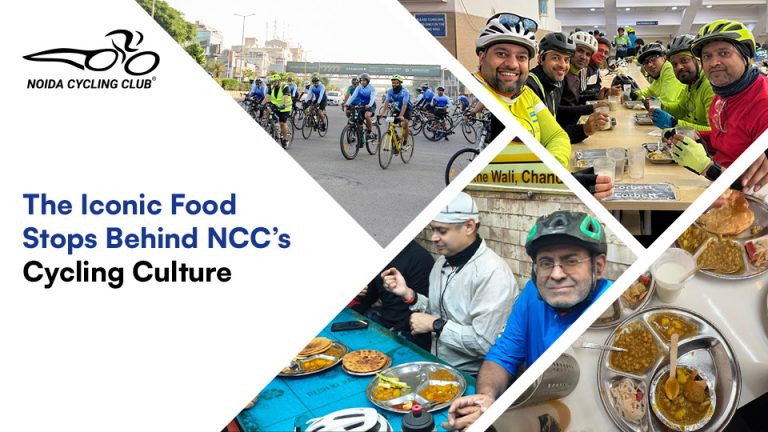
Over the years, NCC has built a distinctive cycling culture around exploring Delhi-NCR through its roads, landmarks, and iconic food stops. From sunrise chai near Khan Market to post-ride breakfasts at Karnataka Food Centre, these pitstops have become an integral part of the club’s riding identity. For many riders, they are not simply places to eat after a long ride — they are part of the experience itself.
Because at NCC, cycling has never been only about endurance or speed. It is also about discovering the city differently — through quiet early morning roads, familiar breakfast tables, roadside conversations, and food landmarks that riders return to week after week. Somewhere between the 5 AM rollouts, sprint sections, and sleepy highway stretches, there’s always another important question waiting to be answered:
“Breakfast kahan kar rahe hain?”
Because over the years, NCC’s cycling culture has quietly built its own food map across NCR — a collection of tea stalls, cafes, dosa joints, and roadside legends that have become as familiar to riders as the routes themselves.
And honestly, some of these places are woven so deeply into NCC ride culture that mentioning them instantly unlocks memories.
The Khan Market tea stall outside the mandir is one of those places.
There’s nothing luxurious about it. No aesthetic interiors. No artisanal menu. Just small cups of chai, early morning conversations, and bicycles lined up while Delhi slowly wakes up around it.
After a ride through India Gate and Lutyens’ Delhi, that chai hits differently.
Riders stand around half-awake, hands wrapped around steaming cups, discussing everything from tire pressures to whether someone attacked the pace line too early. The city still feels quiet at that hour, a version of Delhi most people never get to experience.
And maybe that’s what makes these pitstops special. They belong to the ride.
Then there’s the legendary Karnataka Food Centre stop.
Every NCC rider who has done a Delhi breakfast loop knows the feeling of reaching there hungry after hours on the saddle. The smell alone is enough to revive tired legs. Plates of idli, crispy dosas, and vadas disappear within minutes while riders continue replaying moments from the ride.
The beauty of places like Karnataka Food Centre is that they don’t feel performative. They’ve existed long before cycling cafes became trendy, and somehow that authenticity makes them even better.
The same goes for Tamil Nadu House.
Cyclists arrive exhausted and suddenly transform into food critics debating the perfect chutney-to-dosa ratio. Someone always orders extra vadas for the table. Someone else claims they’re eating “light” before proceeding to finish half the menu.
And somehow, breakfast conversations often last longer than the ride itself.
That’s peak NCC culture.
Over time, these pitstops stop feeling like random food breaks and start becoming rituals riders associate with specific routes and seasons. Certain winter rides feel incomplete without chai afterwards. Popular eating destinations are so deeply tied to NCC routes that riders begin discussing the menu long before the rollout even starts.
Of course, not every favourite stop is part of a carefully planned breakfast route. Some become traditions almost accidentally.
Like Mysore Cafe.
For many NCC riders, it has become one of those comfort stops — dependable, unfussy, and perfectly suited for mornings when all you want after a ride is strong filter coffee and something hot to eat. There’s a rhythm to these cafe mornings now: helmets on tables, phones charging near corners, ride stats being compared while someone orders “just one more coffee.”
Outside cycling communities, people often assume the sport is intensely individual. But anyone who rides regularly with NCC knows the opposite is true.
Cycling is deeply social.
And food is usually where that social side comes alive.
Even iconic North Indian stops have become part of the club’s unofficial food folklore.
Om Chole Bhature, for instance, occupies a very dangerous place in the life of a cyclist trying to maintain “discipline.” Because after burning through kilometers all morning, suddenly the logic becomes very simple:
Calories don’t count after a long ride.
At least that’s what everyone tells themselves while ordering another plate.
And then there’s Jain Chawal Wala — one of those old-school NCR food spots that somehow feels permanently connected to Delhi ride culture. Riders stop there not because it’s trendy, but because it’s familiar. The kind of place that feels earned after hours on the road.
That’s the thing about NCC’s favourite pitstops. None of them are really about luxury or hype.
They’re about association.
The tea tastes better because you arrived there after a foggy winter ride. The dosa feels memorable because twenty cyclists arrived starving at the same time after hours on the road. The chai becomes part of the story because everyone stayed longer than planned.
Over time, these food stops become landmarks in a rider’s memory.
Ask longtime NCC members about their favourite rides, and chances are they’ll mention the food before the route itself. In many ways, these pitstops represent something larger than food. They are pauses that turn long rides into shared experiences.
These moments are what build cycling communities.
That’s why longtime NCC riders often remember the conversations, the laughter, and the breakfast tables just as vividly as the routes themselves. Because over time, the pitstops stop becoming breaks during the ride. They become part of why people ride in the first place.